Contents
- What is hot foil stamping?
- Which printing methods are used for branded packaging?
- How does hot foil stamping work?
- Hot foil stamping, digital printing or screen printing: what is the difference?
- What are the advantages and disadvantages of each printing method?
- Digital printing or screen printing: which is better for packaging?
- When is hot foil stamping the right choice?
- Which logos work best with hot foil stamping?
- Which Packeria products can be hot foil stamped?
- Can hot foil stamping be combined with other printing methods?
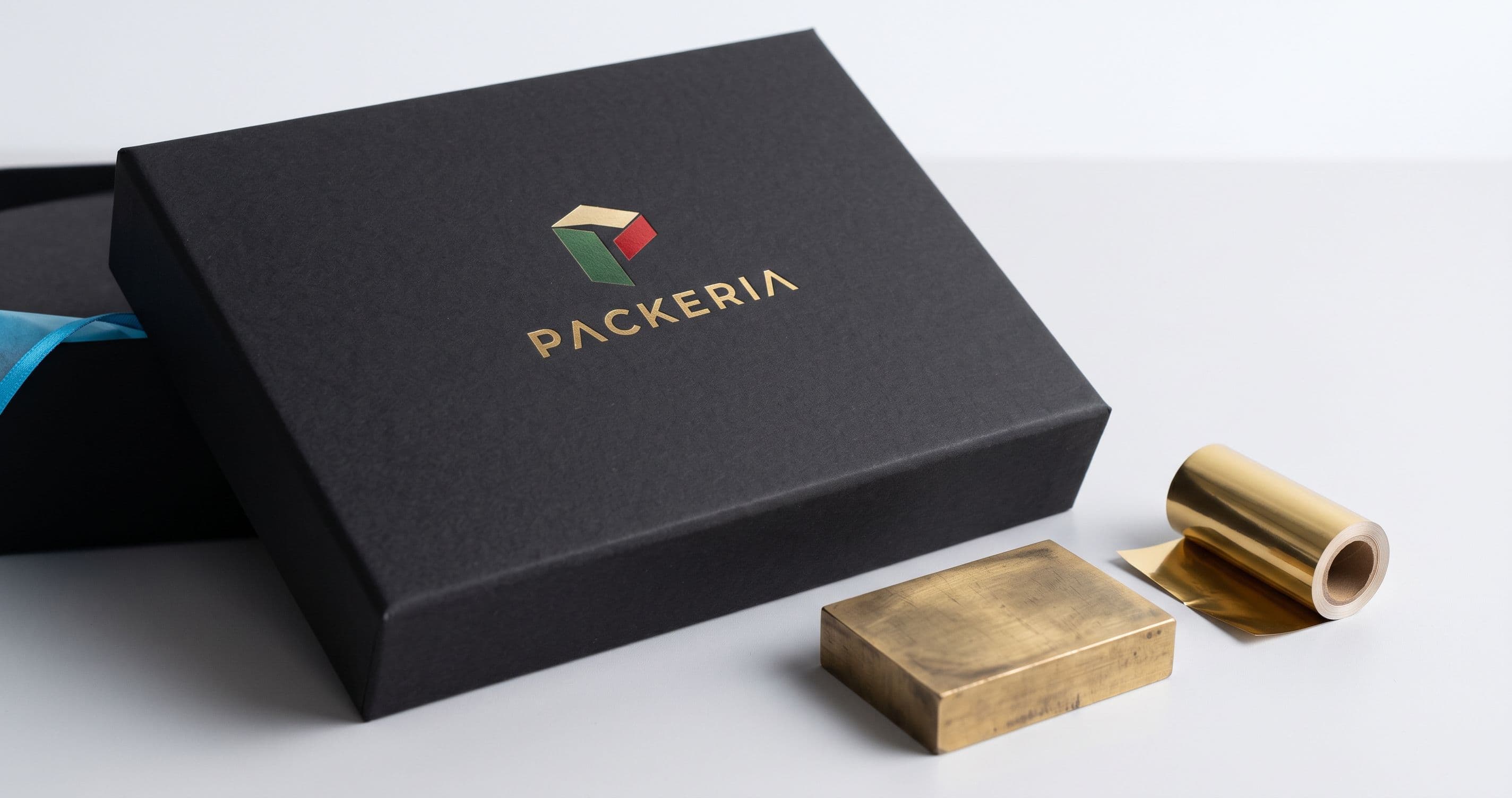
Hot foil stamping is a printing technique that presses a thin metallic or coloured foil onto paper, board or plastic with a heated die. The result is a shiny, sharp logo that cannot be achieved with ink, which is why hot foil stamping is used on premium packaging such as gift boxes, rigid boxes and elegant carrier bags.
This article explains how hot foil stamping works, how it compares with digital and screen printing, which logos work best and on which packaging you can use it.
What is hot foil stamping?
Hot foil stamping is a finishing and printing process for packaging and printed products. A metal die with the shape of your logo is heated and pressed onto a foil that sits on top of the material. Under heat and pressure, the foil releases from its carrier film and bonds to the surface only where the die touches it. What remains is your logo in gold, silver or another foil colour. Because the foil is a layer of its own and not ink, it stays bright and opaque even on dark or strongly coloured paper, where printed ink would lose contrast. The die also presses the foil slightly into the material, which gives the logo a subtle, tactile depth. Hot foil stamping works best for logos, lettering and line art in one colour per foil. It is less suited to photos, gradients or designs with many colours, which are better reproduced with digital printing.
Which printing methods are used for branded packaging?
For branded packaging in small and medium quantities, three methods are most common: hot foil stamping, digital printing and screen printing. Digital printing for packaging means that the design is printed directly from a digital file onto paper or board, without printing plates or screens. Very large runs of standard packaging are often printed with offset or flexographic printing, which only pays off at high volumes. The sections below compare the three methods used for Packeria products.
How does hot foil stamping work?
Preparing the artwork: your logo is prepared as a one-colour design for the area that will be stamped.
Making the die: a metal die (also called a stamp or cliché) is made in the shape of the logo.
Choosing the foil: the foil colour is selected, for example gold or silver.
Stamping: the heated die presses the foil onto the bag or box in a predefined position.
Finishing: the product is assembled, packed and shipped.
Because a die is made for each logo, hot foil stamping is especially efficient when the same logo is applied to many pieces or reordered regularly.
Hot foil stamping, digital printing or screen printing: what is the difference?
Criterion | Hot foil stamping | Digital printing | Screen printing |
|---|---|---|---|
How it works | Metallic or coloured foil is pressed on with a heated die | The design is printed in full colour (CMYK) | Ink is pushed through a fine mesh onto the material |
Colours | One foil colour per stamping | Unlimited, including photos and gradients | Solid spot colours |
Effect | Shiny, premium, slightly tactile | Colourful, detailed | Strong, opaque colours |
Best on | Coloured and dark papers, rigid boxes, fine papers | White and kraft brown board and paper | Corrugated boxes, bags, coloured materials |
Ideal for | Simple logos with a luxury look | Multi-colour logos and full-surface designs | Bold one or two-colour logos |
What are the advantages and disadvantages of each printing method?
Method | Advantages | Disadvantages |
|---|---|---|
Hot foil stamping | Shiny metallic effect that ink cannot achieve, stays bright on dark materials, slightly tactile and premium | One foil colour per stamping, not suitable for photos or gradients, a die is needed for each logo, very fine lines can lose definition |
Digital printing | Unlimited colours, photos and gradients, no die or screen needed, flexible when designs change | No metallic effect, colours look darker on kraft brown than on white material |
Screen printing | Strong, opaque solid colours, thick and durable ink layer, works well on corrugated and coloured materials | Each colour needs its own screen, less suitable for photos and fine gradients |
Digital printing or screen printing: which is better for packaging?
Neither method is better in general; the right choice depends on your logo and your packaging. Digital printing is the better choice for multi-colour logos, photos, gradients and designs that cover large parts of the surface, for example on folding boxes, kraft paper bags and laminated corrugated boxes. Screen printing is the better choice for bold logos in one or two solid colours, especially on corrugated board and coloured materials, where it gives strong, opaque colours. At Packeria, screen printing is used for example on e-commerce boxes, takeaway boxes, shopper-style boxes, round boxes and display boxes, while digital printing is available on most folding boxes, bags and laminated boxes.
When is hot foil stamping the right choice?
Your logo has one colour and consists of lettering, lines or clear shapes.
The packaging is dark or strongly coloured, for example black, turquoise or antique pink paper.
Your brand should look premium: jewellery, cosmetics, fashion, chocolates or corporate gifts.
You want a logo that catches the light and stands out without a full-colour print.
If your logo has several colours or a photo, choose digital printing instead, or combine both methods.
Which logos work best with hot foil stamping?
A good hot foil logo is simple and clear. Solid areas, bold lettering and clean lines reproduce best. Very thin hairlines and very small text can lose definition, so it helps to use a slightly bolder version of your logo for small formats. Contrast matters too: gold and silver look strongest on dark, coloured or kraft brown paper, while a coloured foil on white paper gives a more subtle effect. When you upload your logo as a PNG file with your quote request, our team checks whether it is suitable for hot foil stamping.
Which Packeria products can be hot foil stamped?
Product group | Examples |
|---|---|
Elegant bags, box-style bags, Strong bags, the Gondola and knot handle line, luxury bags with gold or silver finish, transparent plastic bags | |
Gift boxes, cases, trunk boxes, base and lid boxes in mustard, iced mango, antique pink, turquoise, kraft brown or white | |
Base and lid boxes covered with Favini Burano paper in 10 colours, book-style boxes, magnetic closure boxes, shaped boxes | |
Embossed rigid boxes and Elegant bags with a textured paper surface | |
Cake boxes, pastry boxes and sweets boxes | |
Document folders, box files, document cases and dental boxes |
Can hot foil stamping be combined with other printing methods?
Yes. Some packaging combines digital printing for a colourful background with hot foil stamping for a shiny logo, for example selected laminated corrugated boxes, luxury boxes and display boxes. Dental boxes combine hot foil stamping on the lid with screen printing on the inside. A combination gives you the colour freedom of digital printing and the premium effect of foil on the same piece of packaging.
To find the right technique for your packaging, browse our product range and choose the variant with "Hot Foil Print" in its name, or contact us with your questions.
Frequently asked questions
What is hot foil stamping?
Hot foil stamping is a technique that presses a metallic or coloured foil onto paper, board or plastic with a heated die. It creates a shiny, opaque logo that stands out even on dark materials.
Is hot foil stamping more expensive than digital printing?
It depends on the job. Hot foil stamping needs a die for your logo, which makes it efficient for larger quantities and reorders of the same logo. Digital printing needs no die and suits multi-colour designs.
Can a multi-colour logo be hot foil stamped?
Each stamping applies one foil colour. Multi-colour logos are usually better reproduced with digital printing, or with a combination of digital printing and hot foil stamping.
On which materials does hot foil stamping work?
It works on paper, folding boxboard, covered rigid board and plastic. At Packeria it is available on carrier bags, folding boxes, rigid boxes, food packaging and business products.
Is digital printing as durable as screen printing?
Screen printing applies a thicker layer of ink, which makes it very resistant and opaque. Digital printing is durable for normal packaging use, and an optional gloss or matt lamination, available on many Packeria products, adds extra protection.

Packeria Team
The Packeria team supplies businesses across Europe with custom printed bags, boxes and packaging.

